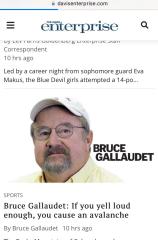
Some individuals’ work in Davis is so visible that they end up personifying their jobs. Today’s guest is one of those folks — Bruce Gallaudet, a longtime, prolific writer about sports in Davis. A former editor and sports editor of the Davis Enterprise, he has retired from the news organization twice, and recently returned for the second time. Officially, he’s now a sports correspondent for the paper.
On today’s Davisville our topics include why he’s back, how he’s working within the limits imposed by a publication that’s a fraction of its former size, and what people miss when they dismiss sports stories as uninteresting. "There's a great deal of flavor in sports," he says.
|
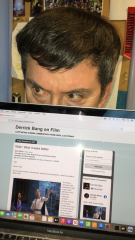
Get yourself settled and turn off your phone, we're raising the curtain on our latest year-end movie show with Davis film critic Derrick Bang. We talk about the effects of this year's writers’ and actors’ strikes, streaming, some of the best and worst movies of 2023, and films he’s looking forward to — or not — during the next several weeks.
Derrick writes for the Davis Enterprise and his blog Derrick Bang on Film (the photo shows Derrick lurking behind a laptop displaying his blog).
|
Jake Berman, who lived in Davis when he was younger, has developed a writer’s interest in something Davis has never had — subways. So he wrote The Lost Subways of North America — a Cartographic Guide to the Past, Present, and What Might Have Been, a new book about transit and how it reflects a city’s personality, interests, and other attributes.
He writes this about the Bay Area, for example -- that after the Freeway Revolt a half century ago, in which San Francisco turned away seven of 10 freeways planned for the city, “the Bay Area adopted a posture that any changes to the urban fabric were presumptively bad, and that exhaustive study of any such changes would be necessary.” We're living with the aftermath of the attitude, which he believes is also present in Davis and other California communities.
Jake, now an attorney in New York City, will speak about his book Nov. 29 at the Avid Reader bookstore in downtown Davis, and joins us today on Davisville. (He also created the transit illustrations in the book -- this image is an excerpt from his map of San Francisco's cable cars in 1892.)
|
Today’s Davisville involves Davis, food, the invention of new food products, and potentially good news for the environment, depending on how this idea develops.
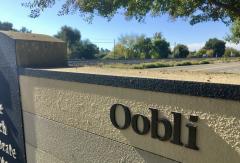
The topic is sweet proteins, a sugar alternative probably new to most of us, and Oobli, a Davis company using these proteins to create sweet teas and chocolates that just went on the market. Our guest is the company’s co-founder and chief technology officer, Jason Ryder. He also teaches at UC Berkeley, where he earned a PhD in chemical engineering.
|
All the baffling cliches you’ve seen in movies — idiot plots, hobbled assailants able to chase down a healthy person trying to escape, bloated tension-killing dialogue — these are all things Derrick Bang has endured over and over during his 49 years of writing movie reviews.
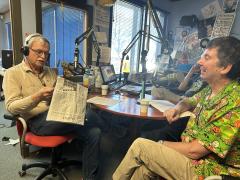
He recently listed several of these cinematic headscratchers in an article for the Davis Enterprise, and on today's Davisville he enjoys going over a few of them with program host Bill Buchanan (the photo shows Derrick on the right, Bill on the left). We also get Derrick’s suggestions for movies for the Halloween season, and his thoughts on the Chinese government’s efforts to punish filmmakers for work it finds offensive, even when the movies in question aren't shown in China. Such pressure could help explain why so many mainstream Hollywood movies are superhero stories, he says. “It’s not just because they’re popular. They’re safe.”
|
At a very simple level, we’re talking today about hamburgers, although the subject goes much deeper than that. Today’s show concerns food, taste, the environment, commerce, questions of how to feed the world — and it’s directly a Davis story, because the University of California at Davis is a national leader in this area of research, and their work is attracting food tech startups to the region. The subject is cultivated meat, or meat substitutes that barely exist beyond the lab for now, but should come eventually to a store or menu near you.
Our guests today are Denneal Jamison-McClung and Kara E. Leong. Kara is the executive director of the UC Davis Cultivated Meat Consortium; Denneal is the director of the UC Davis Biotechnology Program, and co-founded the consortium. They can help us understand what’s happening and why it matters. |
This program first aired on Feb. 1, 2021
I recorded this soon after Joe Biden became president. The U.S. had just endured a bitterly contested election, and the conflicts that tear at the country showed no signs of going away -- then or now. To do more than separate into groups and shout at each other, we need to do a better job of addressing and resolving conflicts. On this edition of Davisville Kara Hunter, executive director of the Yolo Conflict Resolution Center, talks about how to handle conflict, wherever we find it.
She believes the quantity of conflict might not have increased in recent years, but our exposure to it has. Also, people might have become more comfortable sharing their disdain, disappointment and disillusionment. |
Fairfield Mayor Catherine Moy was among the first people a few years ago to draw attention to extensive and secretive land purchases in Solano County by Flannery Associates. Who the buyers are, and what they wanted, has now become much clearer thanks to reporting from The New York Times and other media — Flannery wants to build a green “dream city” from scratch on rural, arid land in southeastern Solano County, one of the least-populated parts of the greater Bay Area and Yolo County’s southwestern neighbor. The backers include some of the wealthiest people in America, with ties to Silicon Valley.
Today on Davisville, Moy criticizes the idea, says the opposition is large and growing, and chides the buyers for conceiving big plans involving Solano County while not engaging the people who live there. “I have literally had several hundred people [in Solano County] contact me,” she says, "and about 95, 96 percent want them to go away. For a number of reasons.”
After this interview was recorded, Flannery began saying more about its plans. This SFGATE article has details.
|
Sonora Slater is the 2023-24 editor of the California Aggie, whose days as a printed newspaper for students at UC Davis are largely over. It prints 4,000 copies each Thursday during the academic year, and Slater says a lot end up in recycling bins, not in the hands of students. The Aggie has a larger presence online, but many of UC Davis’ 40,000 students don’t seem to know it exists.
Slater intends to change that. She wants to draw students back in, through new products — such as a 15-20 minute podcast twice a week, timed to fit students’ bike commutes — and a larger focus on stories that interest students, not only the journalists. Plus use of Instagram takeovers, use of social media for updating news, new events with student groups, maybe a caption contest ... she has a list. We talk about all this today on Davisville.
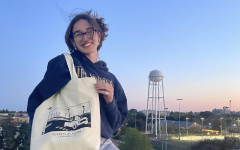
The photo shows Slater atop the Hutchison parking garage at UC Davis, a scene recreated on her tote bag.
|
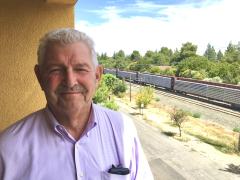
Bill Pride is retiring this fall, and this is news because he has been really influential in addressing homelessness in Davis, at several levels. He started with Davis Community Meals and Housing 30 years ago as a volunteer with its Saturday meal program, and will leave this fall as its executive director. The nonprofit has helped create 160 units of permanent supportive housing for the homeless in Davis, as well as transitional housing and other services to help people, and has grown along with the need — this photo shows Pride on the fourth floor of Paul’s Place, the DCMH project that opened four months ago on H Street. |